
The government has been urged to acknowledge the shifting opinions and sensitivities of the British public towards gambling and its presence in everyday life and local communities.
The advice headlines new research by think-tank More in Common, undertaking a “public insights” study on gambling policy for the Coalition to End Gambling Ads (CEGA). The group said its mission was to “bridge the gap between policymakers and the public by helping people in Westminster understand those voters who feel ignored or overlooked by those in power.”
CEGA continues to campaign for MPs and councils to demand urgent restrictions on gambling advertising and sponsorships. Led by reform advocate Will Prochaska, the initiative is backed by local authorities in Hackney, Enfield, Barnet and East Suffolk.
Published on 1 January 2026 and titled Ending a Losing Streak, the report presents what it describes as the most detailed account yet of public attitudes toward gambling and advertising exposure within British communities.
Ministers are warned that, while the public remains largely tolerant of gambling itself, they feel “bombarded by gambling promotions and under-protected from harms.”
Conservative peer Sir Iain Duncan Smith, who signed the foreword, said: “Even those who gamble support a tougher stance on the industry, supporting moves to track expenditure and ensure limits on unaffordable losses. In fact, more gamblers want the sector to shrink than to grow. These findings directly contradict the gambling industry, which repeatedly claims to represent the views of gamblers when it demands looser regulation.
“Public faith in the institutions that are supposed to protect us from the harms of gambling has been eroded. Only a third of the wider public have any trust in the Gambling Commission to properly regulate the sector.”
Public feedback
The report bases its analysis on polling that segments the British public according to their core beliefs, values, and behaviours towards gambling. This methodology moves beyond the traditional left-right political spectrum, providing deeper insight into how different social groups perceive gambling and its impact on daily life.
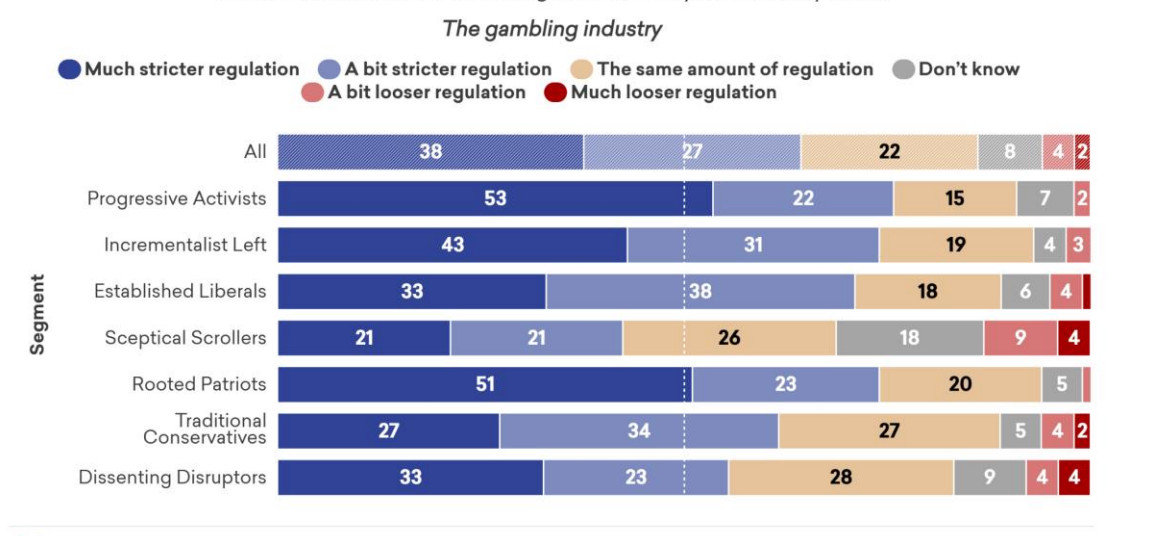
The “seven segments” of public sentiment are defined and weighted as Progressive Activists (12%), Incrementalist Left (21%), Established Liberals (9%), Sceptical Scrollers (10%), Rooted Patriots (20%), Traditional Conservatives (8%), and Dissenting Disruptors (20%).
Across all segments, the findings show high concern about the saturation of gambling in society. Two-thirds of respondents said gambling has become “more noticeable than ever,” particularly through television advertising (63%), online promotion (62%) and sports sponsorship (61%). Raising concerns were further detailed in how gambling exposure increasingly appears in ‘unexpected settings’ such as food-delivery apps offering “free spins” or promotional offers sent to individual homes.
Saturation emerges as a central theme as most Britons believe gambling promotion has reached unhealthy levels comparable to pre-ban tobacco marketing. Sentiments are especially protective of young people: 68% believe under-18s should not see any gambling advertising, while a majority support policies to treat scratchcards and lottery tickets like cigarettes — hidden from sight at checkouts.
Sports sponsorships are identified as a key driver of the “normalisation of gambling coverage”, with roughly half of respondents backing an immediate ban on football sponsorships.
Amongst feedback consensus warns that gambling is now “omnipresent in British culture” and that its exposure warrants regulation on par with restrictions seen on alcohol and tobacco.
Distrust in authority
Beyond the changing attitudes of gambling, the research reveals a deepening distrust in regulatory and charitable institutions working in harm reduction.
Of concern, respondent segments expressed a decline in confidence that either the Gambling Commission or ‘industry-funded charities’ are effective in protecting or reducing harms. Only one-third of Britons say they trust the Commission to regulate the sector properly, while half report little or no trust.
“Programmes such as GambleAware, GamCare and even the Gambling Commission itself are seen by many Britons to be offering token gestures towards reducing and preventing rates of addiction, which fall far short of what is needed.”
Focus-group participants described current safeguards as superficial, viewing campaigns such as “When the Fun Stops, Stop” as cynical marketing rather than genuine harm-reduction tools.
Criticism also extends to industry-funded initiatives such as GambleAware and GamCare, which respondents see as too close to operator interests. Many regard the current system as one that “polices itself” and therefore lacks independence or credibility. Others described these efforts as “half-arsed attempts to appease regulators while continuing to profit from addiction.”
An “easy win” for ministers
The report argues that public trust in gambling’s governance has eroded sharply, with many doubting both the capacity and will of existing authorities to prevent harms. The research cites that the current framework is “too weak to curb the worst excesses of the industry.”
However, at the lowest point of distrust, the report presents an opportunity for policymakers to drive change, describing gambling reform as an “easy win’ – a rare area of public policy where decisive action would be both popular and politically uncontroversial.
Some 65% of Britons support tougher regulation, a higher proportion than for tech or financial services oversight. Support cuts across party lines, uniting Labour, Conservative and Reform voters in the view that the gambling sector requires firmer control and greater accountability.
The authors frame gambling reform as a “politically low-risk, high-reward opportunity”. Public opinion now views gambling harm as a public-health issue, which commands consensus across the key voter blocs that secured Labour’s 2024 victory — the Progressive Activists, Incrementalist Left and Rooted Patriots.
As such gambling reform is “a rare policy that protects people from harm, costs the government nothing, and enjoys widespread public backing.” Ministers therefore are urged to act decisively to “rebuild confidence in regulation and show leadership on an issue that cuts across communities.”
The research identifies advertising reform as the most visible and immediate way to regain public trust. Two-thirds of respondents cite that under-18s should not be exposed to any form of gambling adverts/promotion presenting a platform to deliver positive change.
Labour 2026 Agenda
The Labour government and the Gambling Commission will continue to implement the regulatory changes and reforms initiated under the Gambling Review, finalised across 2023 and 2024.
Major adjustments will also be applied to UK gambling licences to accommodate the new gambling tax plan announced in the 2025 Autumn Budget, under which remote gaming duty on online casino and slots will rise from 21% to 40% from 1 April 2026. Further fiscal measures have been scheduled for April 2027, when the government will introduce a new 25% general betting duty on remote sports betting operations.
The Treasury has reframed these changes as part of a fairer and more progressive system designed to align online betting and gaming with their social impact, while also strengthening the UK’s tax base.
Further challenges see 40 local councils continuing their campaign to secure expanded powers over the licensing and planning of gambling venues, citing community concerns about the growing encroachment of betting shops and high-street arcades.
As stands, the Labour government has not launched a formal consultation on gambling advertising. However, in re parliamentary debates, DCMS ministers Stephanie Peacock MP and Baroness Twycross have acknowledged growing political concerns around gambling exposure and the prominence of betting marketing.
Both ministers stated that the government remains committed to an evidence-led approach to future advertising reform, particularly focused on protecting young audiences and reviewing statutory tools to strengthen public safeguards.