Blackjack is not one game but many. A payout of 6:5 instead of 3:2 adds about 1.4 percentage points to the house edge, and smaller rules (soft 17, doubling after a split, surrender, deck count) move it by roughly 0.1 to 0.2 percentage points each. Table rules differ and change the cost of the game.
Blackjack can be one of the lowest-cost games in a casino, but only under the right rules. With basic strategy, most games carry a house edge of roughly 0.5% to 1%. The same cards under worse rules can cost the player several times more. The rules are printed on the table layout or in the game information, and they matter more than most players expect.
What house edge means
The house edge is the average share of each wager the casino keeps over a very long run. At a 1% edge, the casino keeps 1 unit on average for every 100 units wagered. It describes an average, not what will happen in one session, which can end far above or far below it.
Payout for a blackjack: 3:2 or 6:5
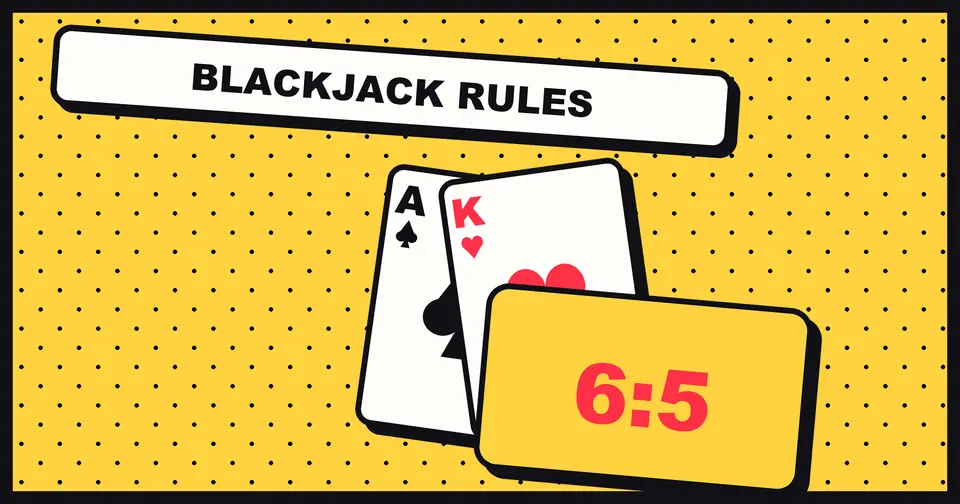
A natural blackjack normally pays 3:2, so a 10 bet wins 15. Some tables pay 6:5, so the same bet wins only 12. The difference looks small on one hand but adds about 1.4 percentage points to the house edge.
Here is the arithmetic. About 4.5 hands in 100 are player naturals that the dealer does not match (a dealer natural makes it a push). On a 100 bet, 3:2 pays 150 and 6:5 pays 120, so each natural pays 30 less. Over 100 hands of 100 each (10,000 wagered) that is about 4.5 × 30 = 135, or roughly 1.4% of the amount wagered.
Watch the numbers move
- Play 100 hands at 100 each. That is 100 × 100 = 10,000 wagered.
- On a 3:2 table with a 0.5% baseline, the average cost is 10,000 × 0.005 = 50.
- In a simplified model, about 4.5 hands in 100 are player naturals that the dealer does not match. A natural pays 150 at 3:2 and 120 at 6:5, so each one pays 30 less.
- The 6:5 table therefore costs about 50 + 4.5 × 30 = 185 on average over the same 10,000 wagered.
- The extra 135 is 1.35% of the amount wagered, roughly the 1.4 percentage points usually quoted for 6:5. Hypothetical numbers, shown to explain the method.
Other rules and their effect
The table below shows how single rule changes move the house edge compared with a benchmark game: six decks, dealer stands on soft 17, no doubling after a split, no resplitting of aces, no surrender. Values are approximate, assume correct basic strategy and change when several rules are combined.
| Rule | Compared with the benchmark | Change in house edge |
|---|---|---|
| Dealer hits soft 17 | instead of standing on soft 17 | about +0.19 points (worse for the player) |
| Doubling after a split allowed | instead of not allowed | about −0.16 points (better) |
| Surrender allowed | instead of no surrender | about −0.09 points (better) |
| Resplitting aces allowed | instead of not allowed | about −0.07 points (better) |
| Two decks | instead of six decks | about −0.23 points (better) |
| Eight decks | instead of six decks | about +0.03 points (worse) |
What the numbers cost: a hypothetical example
Suppose you play 60 hands an hour at 25 per hand. That is 60 × 25 = 1,500 wagered per hour. Each extra percentage point of house edge adds 15 to the average hourly cost. A 6:5 table (+1.4 points) therefore costs about more per hour than a 3:2 table, and a dealer who hits soft 17 (+0.19 points) about 1,500 × 0.0019 = 2.85 more. The numbers are invented to show the method; your actual result in any session will differ.
Rules to check on any table
- Does a blackjack pay 3:2? If it says 6:5, treat it as a different, costlier game.
- Does the dealer stand or hit on soft 17? The felt usually says so.
- Can you double after a split, resplit aces or surrender?
- How many decks are in the shoe?
Rules also differ between casinos and between tables in the same casino, so check each table. For the full method behind these numbers see blackjack house edge: worked examples; for how the best play is chosen, see basic strategy, explained.
See also: House edge cost calculator; Gambling glossary.
Frequently asked questions
Is 6:5 blackjack always a bad game?
It costs about 1.4 percentage points more than 3:2 under otherwise similar rules, which is a large increase for blackjack. Many players treat it as a different game for that reason.
Does basic strategy remove the house edge?
No. It minimizes it for a given set of rules. Under typical rules the edge stays positive, commonly 0.5% to 1%.