This guide describes what happens at a blackjack table: how rules are posted, how hands are signalled, what basic strategy and insurance are, and why a budget matters. It is not encouragement to visit a casino. Minimum age depends on the place.
A first visit to a blackjack table can feel stressful. The game itself is simple, and most of the stress comes from unfamiliar procedure. This guide covers the practical points, with no promise that any of them will make you win.
Check the rules on the table
The felt or a sign shows the payout for a blackjack (3:2 or 6:5), whether the dealer hits or stands on soft 17, and the minimum and maximum bet. These rules change the cost of the game, as explained in the rules that raise the house edge. Minimum gambling age also differs between places, and some venues set it at 21 or above.
Buying in and betting
You exchange cash for chips with the dealer, and you place your bet in the betting area before the cards are dealt. Table minimums limit how low you can bet, so the minimum matters for a budget. Once the round starts you cannot change the bet.
Hand signals
In a game where the cards are dealt face up, you usually do not touch them. Casinos rely on signals because the table is monitored:
- Hit: tap the table with a finger or wave a hand toward yourself.
- Stand: wave a flat hand over the cards.
- Double down: place an additional bet beside the original and point with one finger.
- Split: place an additional bet beside the original and show two fingers in a V.
- Surrender (where offered): draw a line behind your bet with a finger.
In handheld games, hitting is usually signalled by scratching the cards against the table and standing by sliding them under the bet. Details vary by casino, and the dealer will correct a mistake.
Basic strategy
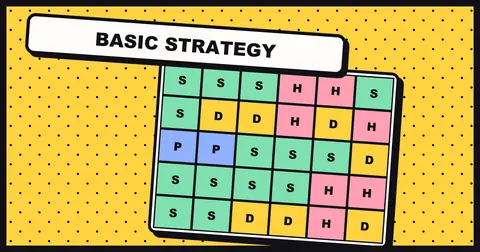
Basic strategy lists the best play for every hand against the dealer's card. Some casinos allow a printed chart at the table; ask the dealer or the floor staff. The method is described in basic strategy, explained.
Insurance and its cost
When the dealer shows an ace, insurance pays 2 to 1 if the dealer has a ten in the hole. In a simplified model with an endless deck, a ten is 4 chances in 13, so the expected result of a 1 bet is , or about −7.7%. Basic strategy never takes it, and the same applies to even money.
Set a budget first
Decide how much you can afford to lose before you sit down, divide it into sessions and stop when it is gone. Do not chase losses with larger bets. For a method, see setting a gambling budget and limits.
See also: Setting a gambling budget and limits; Bankroll planner.
Frequently asked questions
Do I need to know basic strategy before I play?
No, but it is the best way to keep the cost of the game low. Beginners often play a hand slowly while they check a chart, and that is normal.
Should I take insurance?
Over time it costs more than it returns. In a simplified model it loses about 7.7% of the insurance stake, and basic strategy never takes it.