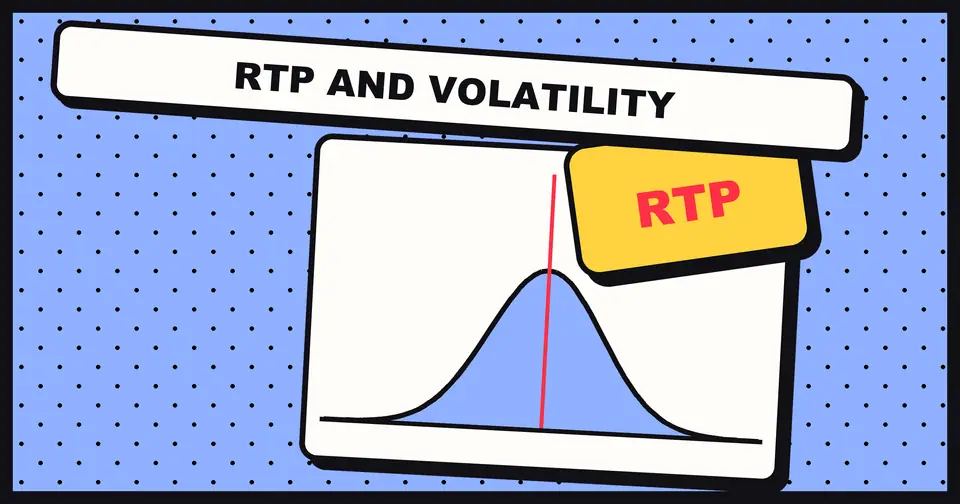
RTP is the share of money wagered that a slot returns to players on average over a very large number of spins; the house edge is 100% minus RTP. Volatility describes how unevenly that return arrives. Neither number predicts what happens in one session.
Two figures describe a slot game more than any theme or graphics: RTP and volatility. They answer different questions. RTP says how much the game pays back on average. Volatility says how bumpy the ride is on the way there.
What RTP means
RTP stands for return to player. It is the percentage of all money wagered that a game pays back over a very long run, usually millions of spins. The rest is the house edge, so house edge = 100% − RTP. A slot with an RTP of 96% has a house edge of 4%.
In a hypothetical example, you play 1,000 spins at a stake of 2. That is 1,000 × 2 = 2,000 wagered. At an RTP of 96% the average cost is 2,000 × 0.04 = 80. Real sessions land above or below that figure, sometimes far above.
What RTP does not tell you
- It is an average over a huge number of spins, not a promise for your session.
- It does not say when wins will come or how large they will be.
- Some games exist in several RTP versions, so check the game information screen for the version you are playing.
Many online catalogs list RTP in a game's info panel. One example is an online slots catalog, which listed 4,743 slot titles when checked on November 12, 2026. The link is given for context only and is not an endorsement.
What volatility means
Volatility, also called variance, describes how spread out the results are. A low-volatility slot pays small wins often. A high-volatility slot pays rarely but sometimes pays a lot. Two games can share the same RTP and feel completely different.
Two slots with the same RTP: a hypothetical example
Take two invented games, both with a stake of 1 and an RTP of 96%.
| Game | How it pays | Typical swing over 100 spins | Average cost over 100 spins |
|---|---|---|---|
| Slot A (low volatility) | Pays 1.92 on every second spin | about 10 | 4 |
| Slot B (high volatility) | Pays 96 on one spin in 100 | about 95 | 4 |
Slot A: 0.5 × 1.92 = 0.96 per spin on average. Slot B: 0.01 × 96 = 0.96. The average cost is the same, but the standard deviation per spin is about 0.96 for A and about 9.55 for B. Over 100 spins it grows with the square root of the number of spins, which gives roughly 9.6 and 95.5. In this invented game, about 37% of 100-spin sessions (0.99100) contain no payout and lose the whole 100 staked, and about 63% contain at least one payout of 96. Results vary widely.
How to use the two numbers
- Read the RTP in the game information, not in the advert.
- Judge volatility by the pay table and the features, because many games do not state it.
- Match the bet size to your budget: higher volatility needs a larger buffer to play the same number of spins.
For how a spin is decided, see how slot random number generators work; for the budget side, see setting a gambling budget and limits.
See also: Session simulator; Are slots ever "hot" or "cold"?.
Frequently asked questions
Does a higher RTP always mean a lower average cost?
A higher RTP means a lower average cost per amount wagered, but it still does not predict a session, and a high-RTP game can be highly volatile.
Can I tell volatility from RTP alone?
No. RTP and volatility are independent. Volatility is usually inferred from the pay table, the features and published game information.