To compare tables, start from a baseline house edge, add or subtract the effect of each rule difference, then multiply by the amount you expect to wager. In a hypothetical comparison, a worse table costs about 27.60 more per hour than a better one. All numbers here are examples.
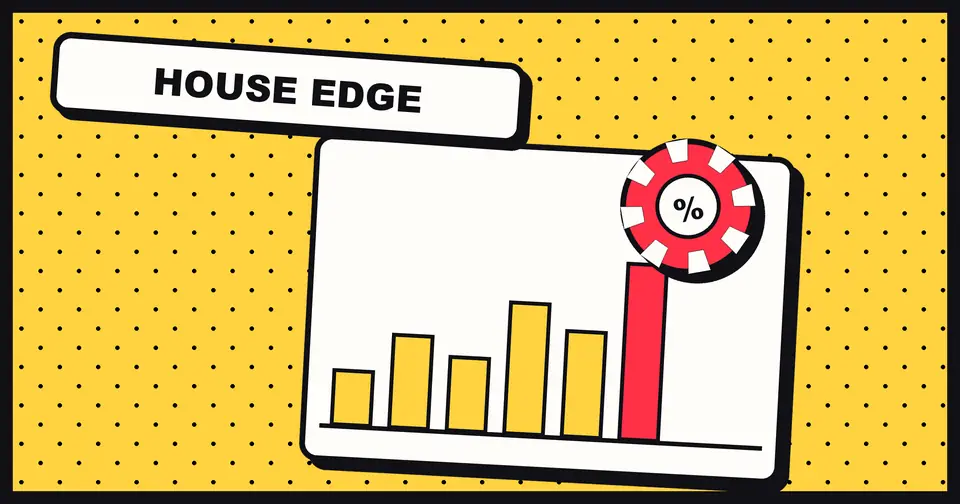
House edge is a percentage. To make it useful, convert it to money: the average cost of play equals the total amount wagered multiplied by the house edge. This guide shows the steps with two invented tables. The numbers are examples, not measurements.
Step 1: start from a baseline
Under typical rules and basic strategy, many 3:2 blackjack games sit between about 0.5% and 1%. For the example, we take a baseline of 0.5% for Table B, a lower-cost game with a 3:2 payout, dealer standing on soft 17, doubling after a split and surrender allowed.
Step 2: add the rule differences
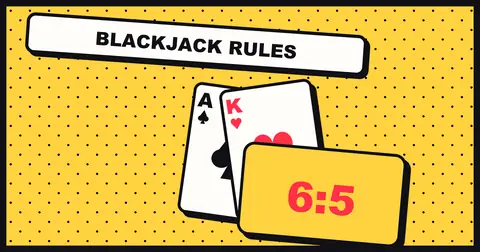
Table A is a weaker game: a 6:5 payout, the dealer hits soft 17, no doubling after a split and no surrender. Using the approximate effects from the rules guide:
| Rule difference (Table A vs Table B) | Added house edge |
|---|---|
| 6:5 instead of 3:2 | +1.40 points |
| Dealer hits soft 17 | +0.19 points |
| No doubling after a split | +0.16 points |
| No surrender | +0.09 points |
| Total | +1.84 points |
So Table A has a house edge of about 0.5% + 1.84% = 2.34%, against 0.5% for Table B. Effects of several rules do not always add up exactly, so treat the total as a close estimate.
Step 3: convert to money
Assume 60 hands an hour at 25 per hand, so the amount wagered per hour is 60 × 25 = 1,500.
- Table B: 1,500 × 0.005 = 7.50 average cost per hour.
- Table A: average cost per hour.
- Difference: 35.10 − 7.50 = 27.60 per hour, or 1,500 × 0.0184.
Step 4: remember the spread
An average cost is not a result. If a hand has a standard deviation of roughly 1.1 to 1.2 bets (a commonly quoted figure), then after 60 hands of 25 the typical swing is about 25 × 1.15 × √60, or roughly 220, far more than the 7.50 average cost. The house edge shows up reliably only over thousands of hands.
Using the numbers
- Compare tables by their rules, not by the size of the minimum bet.
- Estimate your wagers per hour and multiply by the edge.
- Compare the cost of tables for the time you would spend. Not playing costs nothing.
You can run the same arithmetic in the house edge cost calculator. For a fixed budget, see bankroll and bet sizing in blackjack.
See also: Session simulator; House edge cost calculator.
Frequently asked questions
Do the rule effects simply add up?
Approximately. Rules interact, so the total is a close estimate rather than an exact figure.
Does a lower house edge mean I will win?
No. It means the average cost is lower. A single session can still end in a loss.