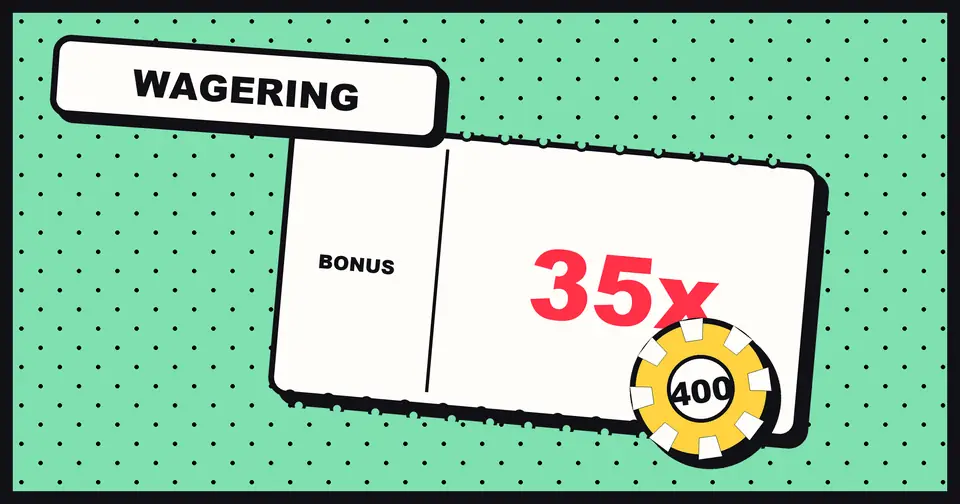
A wagering requirement is the total amount you must stake before bonus winnings can be withdrawn: the multiplier times a base amount. With a 35× multiplier on a 200 deposit plus a 200 bonus, that is 14,000. At a 4% house edge the average cost of that play is 560.
Wagering is the part of a bonus that is easiest to misread. It is multiplication, and the answers are large. This guide shows the arithmetic with invented numbers.
The formula
Wagering requirement = multiplier × base amount. The base is set in the terms: the bonus alone, or the deposit plus the bonus. In most terms only stakes count, not winnings, so a stake of 2 counts as 2 toward the total whether it wins or loses.
A worked example (hypothetical)
You deposit 200 and receive a 200 bonus. The terms say 35× on deposit plus bonus.
- Base: 200 + 200 = 400.
- Wagering: .
- If the multiplier applied to the bonus only: 200 × 35 = 7,000.
What the wagering costs on average
Every stake carries the house edge of the game. On a slot with an RTP of 96% the edge is 4%, so the average cost of wagering 14,000 is 14,000 × 0.04 = 560. On the bonus-only terms, 7,000 × 0.04 = 280.
| Terms | Total to wager | Average cost at a 4% edge | Starting balance |
|---|---|---|---|
| 35× on deposit + bonus | 14,000 | 560 | 400 |
| 35× on bonus only | 7,000 | 280 | 400 |
In the first case the average cost of the wagering is larger than the whole starting balance of 400. In this invented example the average cost exceeds the starting balance, so the balance would often run out before the wagering is complete. The 560 is an average over the full wagering, not an amount that could be lost from a balance of 400. Individual sessions vary. This is an average, not a prediction: single sessions vary widely, as covered in the slot RTP and volatility guide.
Watch the numbers move
- You deposit 200 and receive a 200 bonus, so the balance is 400.
- The terms say 35× on deposit plus bonus: 35 × 400 = 14,000 to wager.
- Every stake carries the house edge. At 4%, wagering 14,000 costs 14,000 × 0.04 = 560 on average.
- The average cost is larger than the balance, so the balance would often run out before the wagering is complete. Hypothetical numbers.
The race: balance against wagering
Race: wagering against balance
Average path of a hypothetical offer: balance falls by the average cost as the wagering progresses. Needs JavaScript.
Game contribution
Not every game counts in full. If table games count 10%, each 10 staked adds 1 to the total. To clear 14,000 on such a game, you would need 14,000 / 0.10 = 140,000 in stakes, ten times as much. Contribution rates differ by operator and game type, and the terms state them. In the invented example slots count 100%.
Reading a multiplier
- A 10× or 20× multiplier requires far less staking than 40× or 50×. This compares amounts and is not a recommendation.
- Compare the base as well as the multiplier: 20× on deposit plus bonus can ask for more wagering than 30× on the bonus only.
- A high multiplier means more play, and more play means a larger average cost.
To run your own numbers, use the wagering requirement calculator. For the other lines of an offer, see how to read casino bonus terms.
See also: Wagering requirement calculator; Setting a gambling budget and limits.
Frequently asked questions
Do winnings count toward the wagering?
Only stakes count. A win does not add to the total, although it may add to your balance, which you can then stake.
Does a bonus add value if the wagering costs more than the bonus?
In this example the average cost of the wagering exceeds the bonus, ignoring that losses are capped at the balance and that single sessions vary widely. This page does not recommend taking or avoiding any offer.