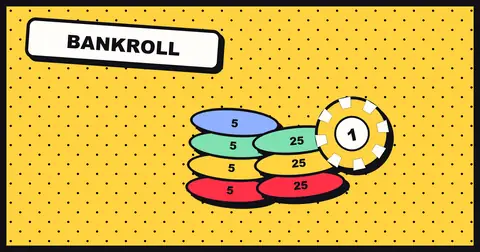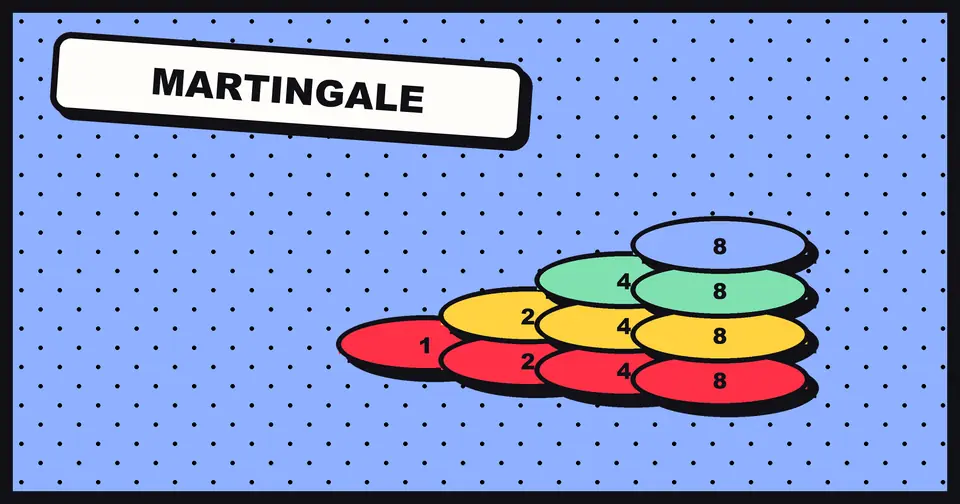
Betting systems such as the Martingale change how stakes are spread over time, not the house edge. Doubling after every loss wins small amounts often but risks very large losses: ten losses in a row on red costs 1,023 units, and tables have maximum bets that stop the doubling.
Betting systems promise to turn a game with a house edge into a winning one by controlling the size of the stake. The mathematics says otherwise: a system changes the pattern of results, not their average.
How the Martingale works
The Martingale is used on even-money bets such as red in roulette. You stake 1 unit. If you lose, you double the stake. When you win, you recover all earlier losses and gain 1 unit, and you start again at 1.
The arithmetic of a losing run
After n losses in a row the total lost is 1 + 2 + 4 + … + 2n−1 = 2n − 1 units, and the next stake is 2n.
| Losses in a row | Total lost (units) | Next stake (units) |
|---|---|---|
| 3 | 7 | 8 |
| 6 | 63 | 64 |
| 8 | 255 | 256 |
| 10 | 1,023 | 1,024 |
How likely is a long losing run?
On a European wheel, red loses with probability 19/37, about 51.35%. Ten losses in a row have a probability of , about 0.13%, or about 1 in 785 series. That sounds rare, but the risk is out of proportion to the reward: to win 1 unit you need a bankroll of at least 1,023.
The average result is still negative
A hypothetical series ends after the first win, or after 10 losses. It wins 1 unit with probability 1 − 0.001275 = 0.998725, and loses 1,023 units with probability 0.001275. The average result of a series is 0.998725 × 1 − 0.001275 × 1,023, about −0.31 units. The system produces many small wins and a rare large loss, and the average remains negative because the house edge has not moved.
Why systems fail in practice
- Table limits. In a hypothetical example, a table with a base stake of 5 and a maximum of 500 stops the doubling after 7 losses in a row (stakes 5, 10, 20, 40, 80, 160 and 320, and the next stake of 640 is above the limit).
- Bankroll limits. Few budgets can absorb stakes that double ten times.
- No effect on the edge. Every stake still carries the house edge, and larger total stakes mean a larger average cost.
Other systems
Progressions that raise stakes after wins, or that add or subtract one unit, change how results are distributed, not their average. The reason is the same: each spin is independent, as explained in the gambler’s fallacy, explained. For the cost of the game itself, see European vs American roulette: house edge.
See also: Martingale simulator; Bankroll planner.
Frequently asked questions
Can the Martingale work with a big enough bankroll?
A larger bankroll lets the system survive longer runs, but the average result stays negative and table limits still stop the doubling.
Is there any betting system that beats the house edge?
Not for games with independent outcomes. A system can change how results are spread, but it cannot change the average.