European roulette has 37 pockets and a house edge of about 2.70% on standard bets. American roulette adds a double zero (38 pockets) and nearly doubles the edge to about 5.26%. The payouts are the same, so the extra pocket is the whole difference.
Roulette looks the same in most places, but one extra pocket changes its cost a lot. The reason is arithmetic, not luck.
The two wheels
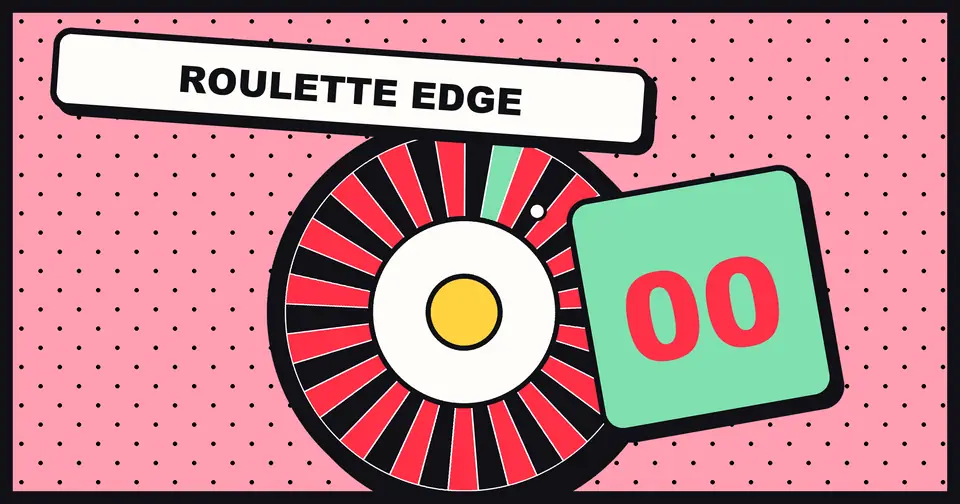
A European wheel has the numbers 1 to 36 and a single zero, 37 pockets in all. An American wheel adds a double zero, 38 pockets. A bet on one number pays 35 to 1 on both, although the true odds are 36 to 1 on a 37-pocket wheel and 37 to 1 on a 38-pocket wheel.
The calculation for a single number
For a bet of 1 on one number, the average result is the chance of winning times the win, minus the chance of losing times the stake.
- European: (1/37) × 35 − (36/37) × 1 = = −1/37, about −2.70%.
- American: (1/38) × 35 − (37/38) × 1 = (35 − 37)/38 = −2/38, about −5.26%.
Outside bets work the same way
A bet on red wins with 18 pockets out of 37, or 18 out of 38, and pays 1 to 1.
- European: (18 − 19)/37 = −1/37, about −2.70%.
- American: (18 − 20)/38 = −2/38, about −5.26%.
Nearly every standard bet has the same house edge as the single number, because the payout is always scaled to the number of pockets covered. The exception on the American wheel is the top line (0, 00, 1, 2, 3), which pays 6 to 1: (6 − 33)/38 = about −7.89%.
What the difference costs: a hypothetical example
| Wheel | House edge | Average cost of 100 spins of 10 (1,000 wagered) |
|---|---|---|
| European (37 pockets) | about 2.70% | about 27.00 |
| American (38 pockets) | about 5.26% | about 52.60 |
The American wheel costs nearly twice as much per unit wagered. Real sessions vary around these averages, and a few spins can end far above or below them.
Rules that lower the edge on even-money bets
Some European-style tables use a rule often called la partage: when the ball lands on zero, an even-money bet loses only half its stake. That cuts the edge on those bets to about 1.35%, since the zero costs 1/37 × 0.5 = 1/74. Check whether a table offers it before you assume it applies.
For every bet and its payout see roulette bets and payouts, explained. For why a run of reds changes nothing, see the gambler’s fallacy, explained.
See also: House edge cost calculator; Betting systems and the Martingale myth.
Frequently asked questions
Is any roulette bet better than another?
On a standard European wheel all standard bets share the same house edge of about 2.70%. They differ in how often they win and how large the payouts are.
Why do the payouts not match the true odds?
The gap between the true odds and the payout is the house edge. The zero pockets are what create it.